
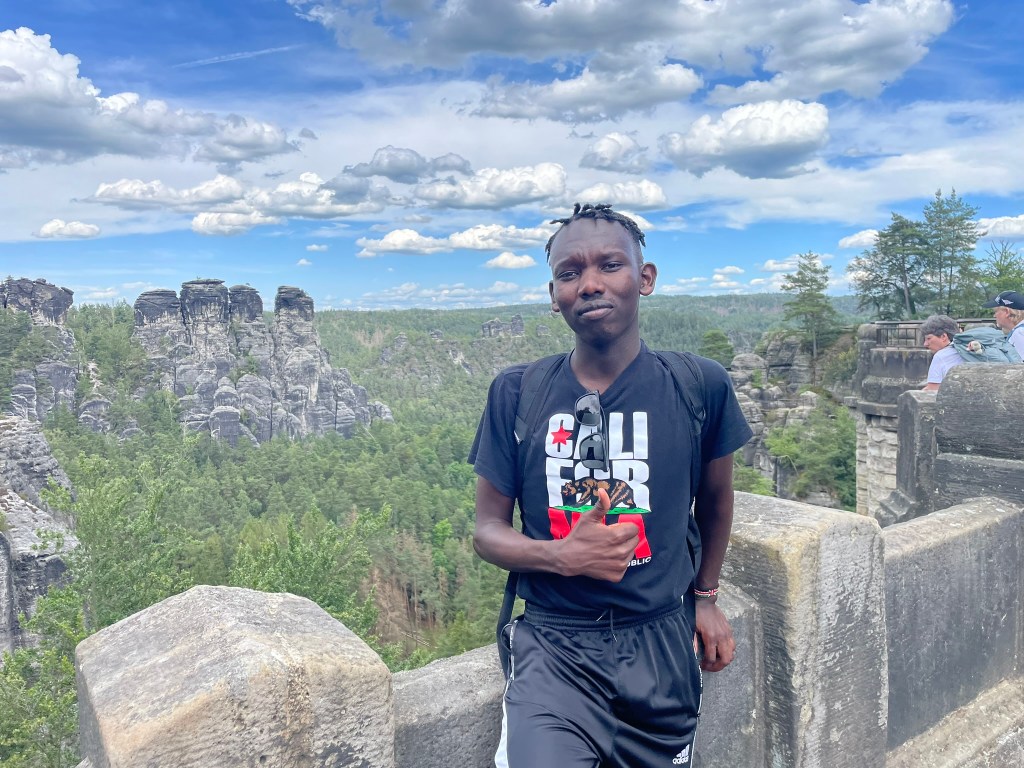
When prompted what my favorite epoch in the canon of German literature would be, I have often responded without hesitation that Romanticism it is. Well represented is this period by the painting by Caspar David Friedrich, Wanderer above the Sea of Fog, where the hiker overlooks the Elbe Sandstone Mountains in a contemplative manner. Last year, as I was hiking through this unique and beautiful landscape, I could immediately sense the transport, the sublime, and transcendentalism evoked by being in this space. Yet, while many would automatically think of romance as associated with love and passion, this is quite the opposite. The Romantic movement in literature was a counter-reaction to the Enlightenment movement, which had prescribed reason and the human capacity for good as a way to truly make connections with the universe. It was thought that human beings could reason and make sound moral choices. The Romantics, however, found this approach too harsh and unaccommodating for human beings whose desires and emotions ought to be expressed, and nature became central to this approach. Although I can comfortably say that I am now shifting more into the contemporary and, more so, life writings, I think autobiographies have a special place in the canon—offering its readers a glimpse of how these individuals came to be and their own processes of navigating life. As the new year starts, I am building more intentionality, and after several attempts to have this essay published in major sites, I have decided to use my platform to talk about the things that matter to me.
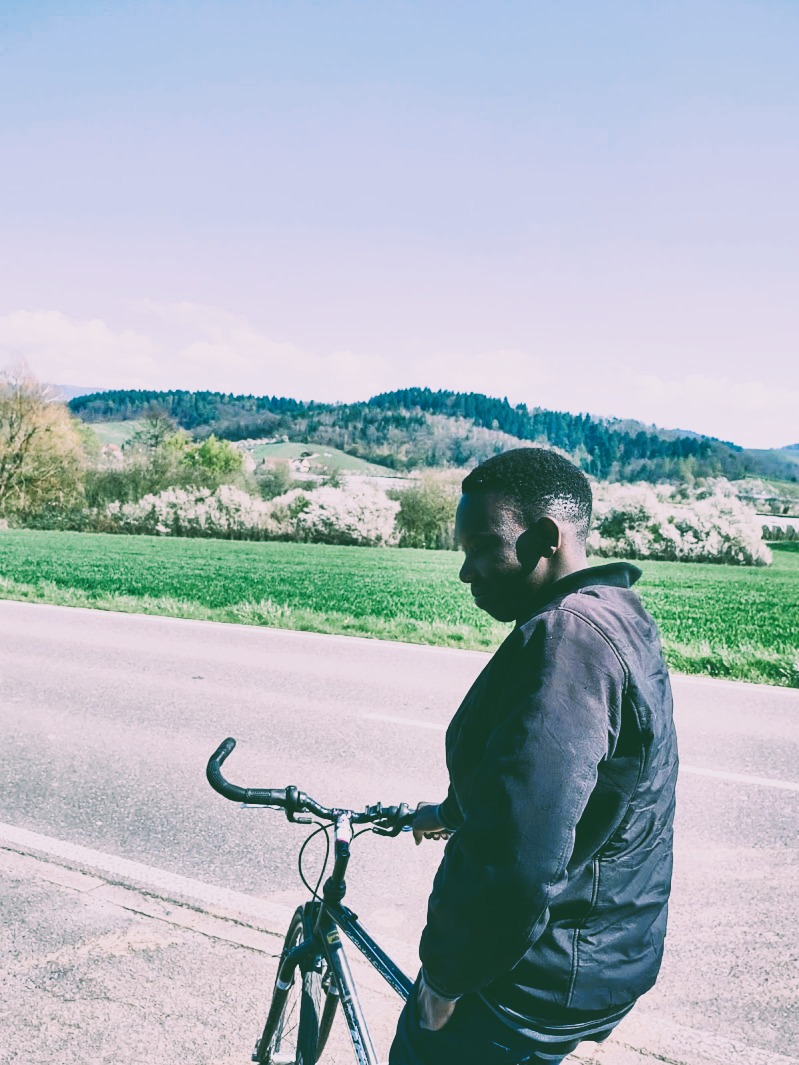
Oftentimes, I have overheard, and especially among men’s circles, the readiness to brand one as ‘too emotional’ and lacking the capacity to deal with things rationally. At one point, a friend predicted with some self-inflicted confidence that my 30s would be smeared with some form of midlife crisis, and that I would fall into the trap set forth by feminists to see the downfall of men—all because I have this unique way of articulating my inner spiritual world. Therefore, allowing myself to view the world from an introspective place has always been my refuge when everyone around me spews hate or negativity, and I have spent time analyzing what it means to exist here and now and to savor each experience with everyone. I don’t know when all this circus began, but ever since I was a little child, I kept desiring the beyond, the different, and the sublime, even if I didn’t have the necessary vocabulary for it.
I was born and raised in Kaptagat, a small village located in the Rift Valley in Kenya. It is probably well known for its high altitude of 8,200 feet and the consequent booming athletics. I grew up with determination and drew lots of inspiration from people around me who had, in their own beautiful and courageous ways, crafted their paths and identities amid what seemed then like little. I thought life was going to be a rewarding experience, especially for me since I had been introduced to what was meant to be the powerful weapon with which I could change the world: education. Later, the education I acquired justified my perks, my preferences, and my unsettling attitudes toward normativity. Listening to my inner self has proven time and again to be my escape mechanism, especially in a society where conformity is the order of the day. I decided to pursue a career which in and of itself felt like an act of defiance, but groundbreaking too: teaching German. I remember one family friend revealing with apparent concern how the field of foreign language teaching was a weak endeavor and that men ought to go into STEM. I still lack words to express this situation, since I am an escapist and tend to gratify everyone and their ideas just so I can escape the moment and boost the ego of the other party.
“I quickly realized that I had a lot of learning and unlearning to do, and in many ways, I think that describes life—thus allowing human beings to be adaptable to new and strange environments. It challenges the simplistic notion that there exists within us an intrinsically fixed nature of existence or one way of doing things or being.”
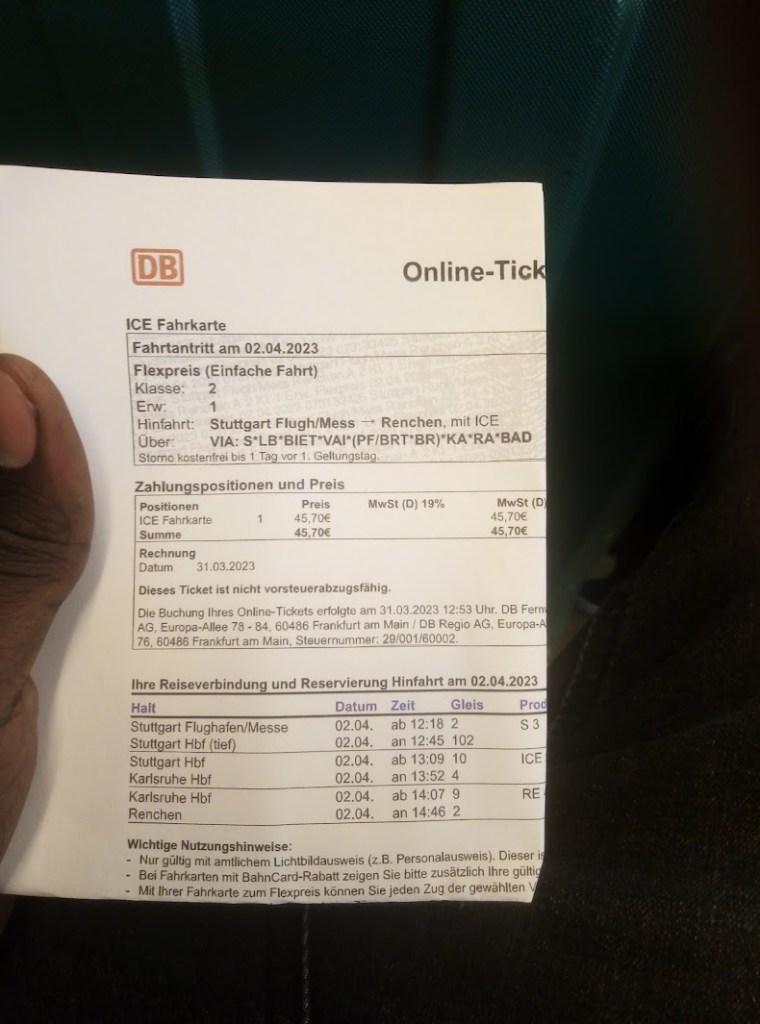
My German language escapades eventually led me to a kindergarten in Germany, in a small village called Renchen-Ulm, where I was participating in an anti-racism and diversity project. Looking back at my simple and innocent milieu, Europe in its majesty smacked a whole shot of culture shock right to my face. For the first time, I was alone, wandering through the busy airports with no clue of where to get my next train connection. I felt lost for a second (or maybe a few minutes). I couldn’t help but notice that I was beginning to feel overwhelmed. My breathing was starting to pace slowly, and I could not breathe well in that cold and crisp air in Stuttgart, which was partly toned with a cigarette smell. What am I doing miles and miles away from home? Why is everyone different? Why is it so cold? I retreated quickly into my emotional state, and before I realized it, I was spiraling into my thoughts and afflictions. Little did I know that this uncomfortable, short-lived experience would be the gateway to something memorable. I didn’t quite toy with the possibility of anything noteworthy stemming from this. Eunice Mwabe says in her Harvard commencement speech that the world is in need of more people who walk through life with this sense of wonder—people courageous enough to engage with that which is different or strange or even unacceptable… I decided to test the waters and use this experience to learn more from the people whose language and culture I had been learning for an extended period of time.
I quickly realized that I had a lot of learning and unlearning to do, and in many ways, I think that describes life—thus allowing human beings to be adaptable to new and strange environments. It challenges the simplistic notion that there exists within us an intrinsically fixed nature of existence or one way of doing things or being. One of the ways I had to adapt was to find a language with which I could express my background and identities, but careful not to border too much on the stereotypical depictions of Africa and the broader Black diasporic narratives. I simply wanted to be me, and coming from Kenya, my identity was limited or confined within the imaginations and realities of ethnic tribes, gender norms and expectations, religious backgrounds, and perhaps even the city I come from. In Germany, I felt the need to zoom out to include the racial component of my identity, which in German-speaking spaces can sometimes feel like walking on eggshells. Needless to say, after time, I developed the necessary bravado and pride with which I could talk about myself without feeling the need to justify more. I was nonetheless excited to immerse myself into the German culture and possibly learn from it, and my immediate contact being the kindergarten I was stationed at became my closest bridge to the German society.
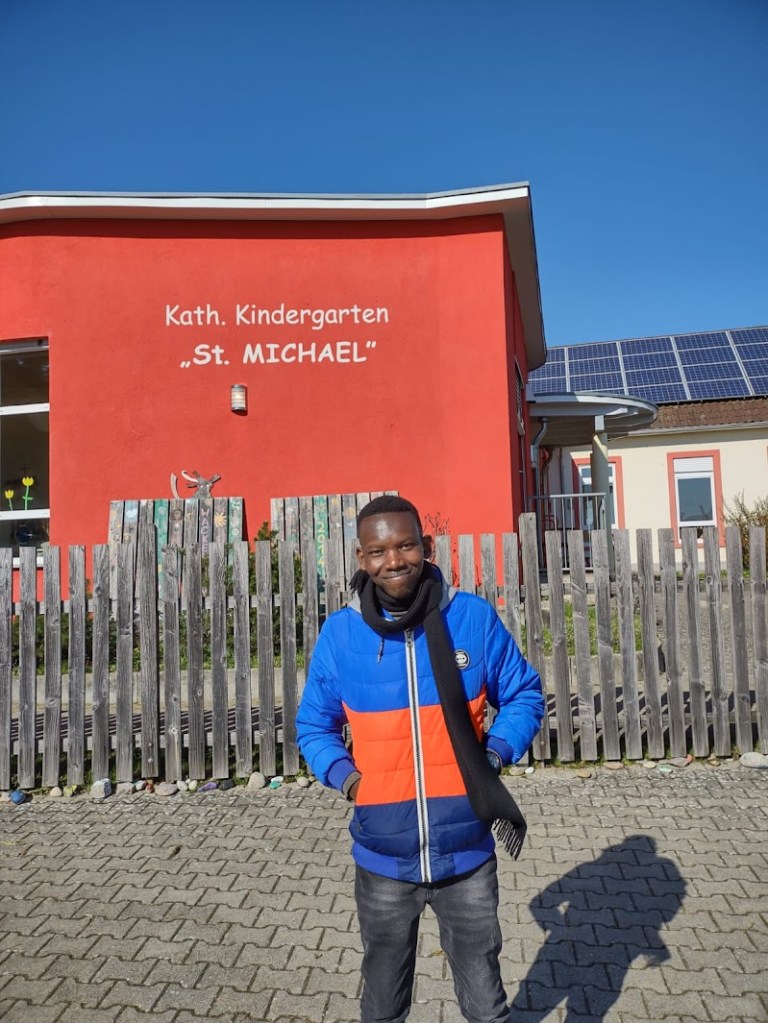
Kindergarten experiences are usually narrated with some tinge of nonchalance by adults. Well, I don’t remember much except for one mean girl who called me soggy pants. I just remember the oddly strong perfume Janet wore. I think there was a kid whose parents had migrated from India. Reflecting on these, I now feel sorry for all the beautiful and memorable experiences that have simply been forgotten by the passage of time. After my three months of experience working as an intern in the Kita, as they would call it, I am given to understand that for many children, the first formal institution they step into is a kindergarten. While this may seem overwhelming for most children, as witnessed by the loud wails in the morning during drop-off, it still functions as a safe encounter for children to start gaining the necessary survival skills that the world would later require from them. But why is such an experience easily forgotten or remembered partially by those who had their portfolios beautifully written down? Or simply, how long can we hold onto those memories?
I am particularly fond of 13 Reasons Why, and while the circumstances surrounding the plot may be morbid or sad, I think there are lessons to pick up from it. Clay Jensen mourns Hannah Baker, who committed suicide, to the point he lets go and says: “The thing I am most afraid of is forgetting you.” It is so interesting that this scene comes up exactly after he had said: “But today, we begin to let go.” Letting go but holding onto the memories for as long as they can seems to me to be the only choice the kids have—not only until they grow up and have to constantly worry about things that press the world. For in growing up, they have lost all that was simple and innocent, and now they have to reason out with their emotions set aside. But I have seen this in the kindergarten reflections. I have met children who have allowed me to speak to them while having my emotional vestment on.
I laughed hard when little Alex and Daniel (names changed) kept tickling me while playing with them at the playground and kept putting grass and leaves into my T-shirt. I was anxious when Moritz accidentally hit Benjamin in the eye and started bleeding immediately, prompting a medical emergency. I was frustrated with myself and the world, when because of cultural or racial difference, I found it extremely frustrating to connect with and relate with the kids. I felt positively overwhelmed when Konrad and his brother Karl invited me to go out with their parents to visit the Black Forest. I cried hard when I had to pack my bags and leave the place that had since shaped me in all the ways I could think of. I was weeping not for the adieu but for the kids. Will they ever remember me? Or will I just be in the photographs and go by as the intern who came from Africa and didn’t speak so much German? As these thoughts surface once in a while, I go back to the beautiful folder which documented my experiences, and in a way, I feel like everyone deserves a folder—highlighting not only the ‘perfect’ graduation, baptism, or marriage. I think all aspects should and can be celebrated—perhaps also the ugly and gore, because in these narrations lay a story about stumbling, which is perfectly in order.
“In what lay happiness if not in the knowledge that she had not lived in vain, but had been creative with her body and her mind and that in a certain sense at least, personal immortality consisted precisely in this implanting of parts of herself and her mind into others.”
It has been exactly two years since I left the kindergarten and moved to the USA to pursue a master’s degree in German Studies, and recently it hit me hard that I am starting to forget my short-lived but extremely memorable experiences from the internship. It became clear to me that I was in my own space and time, and perhaps rightly so, meeting the constant pressing needs of this world, which, as had been promised, would lead to a happier life. I am pausing to notice that life is moving at a fast pace, and there hardly seems to be a moment to pause and think of the things that matter. One writer, Margaret Ogolla in I Swear by Apollo, captures this perfectly and says: “…in what lay happiness if not in the knowledge that she (the protagonist) had not lived in vain, but had been creative with her body and her mind and that in a certain sense at least, personal immortality consisted precisely in this implanting of parts of herself and her mind into others?” Nothing seems to make sense in the grand scheme of things, when all I can think of is the fact that life is one big playground and whose longevity is compared to that of the morning dew—disappearing at the slightest touch of twilight—this personal immortality. I meant it from my heart when I wanted to hold on dear to the memories of what made me happy, sad, confused, tired, and nervous. I didn’t mean to forget when life was speaking to me in its fullness, offering me whispers of positivity that saw me get along. In retrospect, although I wanted to forget the ugly too, perhaps that’s what I need more—a constant reminder of who I am in the face of sorrow, anger, and bitterness, but perhaps even more the tensile strength to reel back and continue with life, head held up high. But why am I forgetting these moments? What does this even mean for the future and for the memories I promised to hold on dear to myself? Will I ever remember the tiny little bits of moments which shaped the person I am today, or will I just smile as I stare at the well-captured photos of me laughing and making merry with everyone around me?
Lately in my research, and out of personal curiosity and interest, I have found myself engaging more with the concept of liminal aesthetics, which ideally concerns itself with anything of an in-between nature or state. Close to it too, and especially within the realm of the now ubiquitous liminal visual aesthetics, is the concept of backrooms. Generally, what these two ideas explore is zooming out on spaces that, on an otherwise normal day, are desolate and empty in the evening, evoking a feeling of transition or eeriness. A hobby I am also growing is collecting these liminal spaces—playgrounds, airports, drug stores, hallways, streets, and intersections, among others. I have thus found myself strolling the streets of Tucson in the weird hours of the night, just to experience this touch and what I am hoping to achieve in doing this is, is to put myself in a reflective state—to zoom out from the normal order of things and explore life with this deep sense of sight.

Having a chance to reflect on this experience has shaped the way I presently look at life. I no longer take any little experience for granted and try to make every second a moment worth experiencing, which shaped my understanding of memory—I am not creating memories to watch later; I am experiencing them here and now and perhaps saving them for later too. This is well captured in a quote I heard somewhere: “Die Glücksmomente sind überall im Leben verteilt.” Happy moments are distributed equally along life. Now I am careful if not intentional in how I experience places and how I treat people. I experience life as though this is the last time such an event is going to occur, and with that, I am flushing away the future possibility of reflecting back and nostalgically crying over memories which did not register properly.
Bio
Gideon Kiptoo is now a PhD student in German literature and culture at Penn State University, with interdisciplinary interests in African studies. He enjoys researching on migration, liminality and illness, disability and death. He also maintains a personal blog.
 Introduction
Leave a Reply